Local jurisdiction · California
San Francisco Zoning, Planning & Building Codes
How San Francisco regulates land use and construction — the Planning Code, residential zoning districts, height & bulk designations, discretionary review, the Department of Building Inspection, the Rent Ordinance and the city's ADU program.

Key points
The San Francisco Planning Code governs how land may be used across the city — what can be built, where, and at what density — while the San Francisco Building Code governs how it is constructed. Land use is organized into zoning districts: RH (Residential, House), RM (Residential, Mixed), RC (Residential-Commercial) and the various NC (Neighborhood Commercial) districts. Sorting out which district applies to a parcel, and what it allows, is exactly the kind of question GoCodebook answers with citations.
San Francisco layers its own rules on top of the statewide California Building Standards Code and state housing laws. Recent density-exception ordinances now allow up to four units per lot (and up to six on corner lots) in many RH districts, and the city runs its own Accessory Dwelling Unit (ADU) program under the Planning Code. Because outcomes depend on the specific district, lot and building age, a plain-English, cited answer saves time before you file.
Zoning districts & the Planning Code
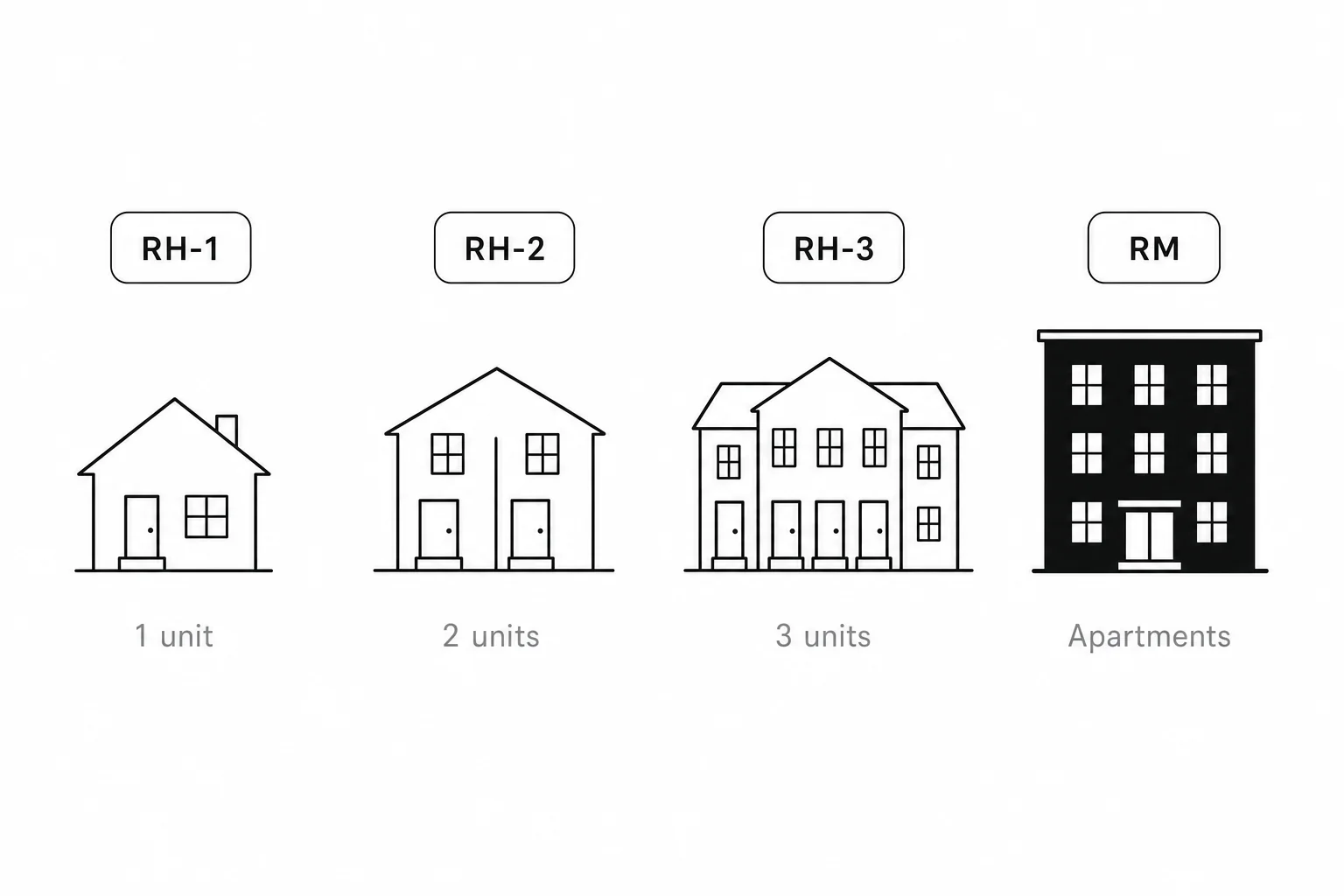
San Francisco's residential districts run from RH-1 (one house per lot) and RH-1(D) (detached, with side yards) through RH-2 and RH-3 (two and three units), up to RM districts that mix houses and apartments and RC and NC districts that combine residential with ground-floor commercial uses.
| District | Name | Typical use |
|---|---|---|
| RH-1 / RH-1(D) | Residential, House — One Family | One unit per lot; (D) requires a detached form with side yards |
| RH-2 / RH-3 | Residential, House — Two / Three Family | Two- and three-unit house-scale buildings |
| RM-1 … RM-4 | Residential, Mixed | Houses and apartments at rising density |
| RC-1 … RC-4 | Residential-Commercial | Housing with commercial uses |
| NC, NCT, NCD | Neighborhood Commercial | Ground-floor retail with housing above; NCT is transit-oriented |
Each district sets its own controls on density, height, bulk, setbacks and permitted uses. To see where the city has detailed coverage, check our coverage page, and compare neighboring peninsula rules in Palo Alto or Cupertino.
Reading a San Francisco zoning designation
Beyond the use district, every parcel also carries a height and bulk designation — written like 40-X. The two parts control the building envelope:
- Height limit — the number is the maximum height in feet (e.g. 40 in
40-X; common limits include 40, 65 and 105 ft). - Bulk district — the letter limits a building's plan dimensions and is meant to break up massing. X means no bulk controls; letters such as A–G cap maximum length and diagonal dimension above a certain height.
A 2023 density-exception ordinance allows up to four units on most lots — and up to six on corner lots — in many RH districts, layered on top of state density law. What a specific parcel allows still depends on its district, height/bulk and lot.
Discretionary review & conditional use
San Francisco is known for a discretionary process. Many projects are not approved purely over the counter: a use may require conditional use (CU) authorization from the Planning Commission, and most residential building permits trigger Section 311 neighborhood notification, during which any member of the public can request discretionary review (DR) of the project before the Commission.

Because any neighbor can file a discretionary review during the Section 311 window, a permit that looks code-compliant can still face a hearing — timelines in San Francisco often hinge on this step.
Building permits & the Department of Building Inspection (DBI)
Construction permits are issued and inspected by the Department of Building Inspection (DBI), which enforces the San Francisco Building, Housing and related codes — themselves amendments to the statewide California Building Code and Residential Code. Most projects move through Planning review for zoning compliance first, then DBI for the building permit and inspections.
A change of use — for example, converting commercial space to residential, or legalizing a unit — often requires both Planning sign-off and a DBI permit. DBI also handles housing-code enforcement and habitability complaints. Browse the full set of statewide model codes on our California Building Standards Code hub.
Rent Ordinance & ADUs
San Francisco has its own Rent Ordinance, administered by the SF Rent Board. Whether a unit is rent-controlled on price turns largely on the building's age, while just-cause eviction protections reach more broadly.
| Topic | Rule of thumb |
|---|---|
| Price controls (rent cap) | Units with a first certificate of occupancy before June 13, 1979 |
| Newer units | Generally exempt from the cap (Costa-Hawkins), but still under just cause |
| Just-cause eviction | Covers most residential units regardless of age |
| Annual increase | Set yearly by the Rent Board (CPI-based) |
| Administration | San Francisco Rent Board |
The key rent-control question is the building's age — a first certificate of occupancy before June 13, 1979 is the classic trigger for price controls. This local ordinance is stricter than, and runs alongside, the statewide AB 1482 cap — see our rent control overview.
The city also runs a local ADU program under the Planning Code that lets owners add accessory dwelling units to existing residential buildings, subject to its own controls. Because ADU and rent-control coverage both hinge on the building's age, type and history, the safest move is to check the specific property. Compare how rent-controlled Los Angeles handles similar questions.
Who this affects
Frequently asked questions
What does San Francisco zoning mean by RH-1, RH-2 and RM?
RH-1 is a single-house district (one dwelling per lot), RH-2 and RH-3 allow two and three units, and RM (Residential, Mixed) districts permit a mix of houses and apartments. Recent density-exception rules also allow up to four units per lot — and six on corner lots — in many RH districts.
What does a height and bulk designation like 40-X mean?
The number is the maximum height in feet (40 ft in 40-X) and the letter is the bulk district that limits a building's plan dimensions. X means no bulk controls; letters A–G cap length and diagonal dimension above a set height.
What is discretionary review in San Francisco?
After Section 311 notification of a residential permit, any member of the public can ask the Planning Commission to take discretionary review (DR) of the project — an extra hearing that can modify or, rarely, deny an otherwise code-compliant permit. It is a defining feature of building in San Francisco.
Who issues building permits in San Francisco?
The Department of Building Inspection (DBI) issues construction permits and performs inspections under the San Francisco Building Code, which amends the statewide California Building Code. Planning typically reviews zoning compliance before DBI issues the permit.
Is my San Francisco unit under rent control?
Generally, residential units in buildings with a first certificate of occupancy before June 13, 1979 are subject to the Rent Ordinance's rent-increase limits; newer units are usually exempt from the cap but still covered by just-cause eviction rules. See our rent control overview.
Can I build an ADU in San Francisco?
In most cases, yes. San Francisco operates a local ADU program under the Planning Code that allows accessory dwelling units in existing residential buildings, subject to its own size, location and design controls layered on top of state ADU law.
General information, not legal advice.
More in San Francisco code
Have a San Francisco zoning or permit question?
Ask GoCodebook about any San Francisco address and get a cited answer on zoning districts, height & bulk, discretionary review, DBI permits, the Rent Ordinance and ADUs.
Ask your question