Local jurisdiction · California
Los Angeles Zoning, Planning & Building Codes
How Los Angeles regulates land use and construction — the LAMC zoning code (old Chapter 1 and the new Chapter 1A), zone strings and height districts, the Rent Stabilization Ordinance, LADBS permits, the TOC program and ADUs.
Key points
The Los Angeles Municipal Code (LAMC) sets the city's zoning rules, and Los Angeles is mid-transition between two systems: the long-standing Original Zoning Code (Chapter 1) and the modernized New Zoning Code (Chapter 1A) adopted in late 2024 under the re:code LA effort. Chapter 1A is being phased in by Community Plan area, starting with the Downtown Community Plan, while most of the city still runs on Chapter 1. Knowing which code applies to a given parcel is exactly the kind of question GoCodebook answers with citations.
On top of zoning, Los Angeles layers its own Rent Stabilization Ordinance (RSO), incentive programs like Transit Oriented Communities (TOC), and the statewide California Building Standards Code enforced locally by LADBS. Whether a project is by-right or needs discretionary approval, and whether a building is rent-stabilized, both depend on the address — so a plain-English, cited answer is the fastest way to get oriented.
Two zoning codes in transition: Chapter 1 vs. Chapter 1A
Most of Los Angeles is still governed by the Original Zoning Code (LAMC Chapter 1), which uses familiar zone strings (such as R1, RD and R3) to set use, density, height and yard rules. The New Zoning Code (Chapter 1A), adopted in 2024 through re:code LA, restructures zoning into a clearer modular form and is being applied area by area as Community Plans update — beginning with the Downtown Community Plan effective in 2025.
| Original Code — Chapter 1 | New Code — Chapter 1A (re:code LA) | |
|---|---|---|
| Status | Governs most of the city today | Adopted 2024; phased in by Community Plan area |
| Structure | One zone string sets use, density, height and yards | Modular form-, frontage- and use-based districts |
| First area | — | Downtown Community Plan (effective 2025) |
| Zone example | [Q]R3-1XL | New form & development-standards districts |
Which zoning code applies to a parcel — Chapter 1 or Chapter 1A — depends on its Community Plan area. Until that plan transitions to 1A, the parcel stays on Chapter 1, so always confirm the controlling code for the specific address.
Because the two systems coexist, the same kind of project can follow different rules depending on which plan area it sits in. Some projects are approved by-right (ministerially), while others require discretionary review. See where we have detailed coverage on our coverage page, and compare the simpler single-code setups in Cupertino and Palo Alto.
Anatomy of a Los Angeles zone string
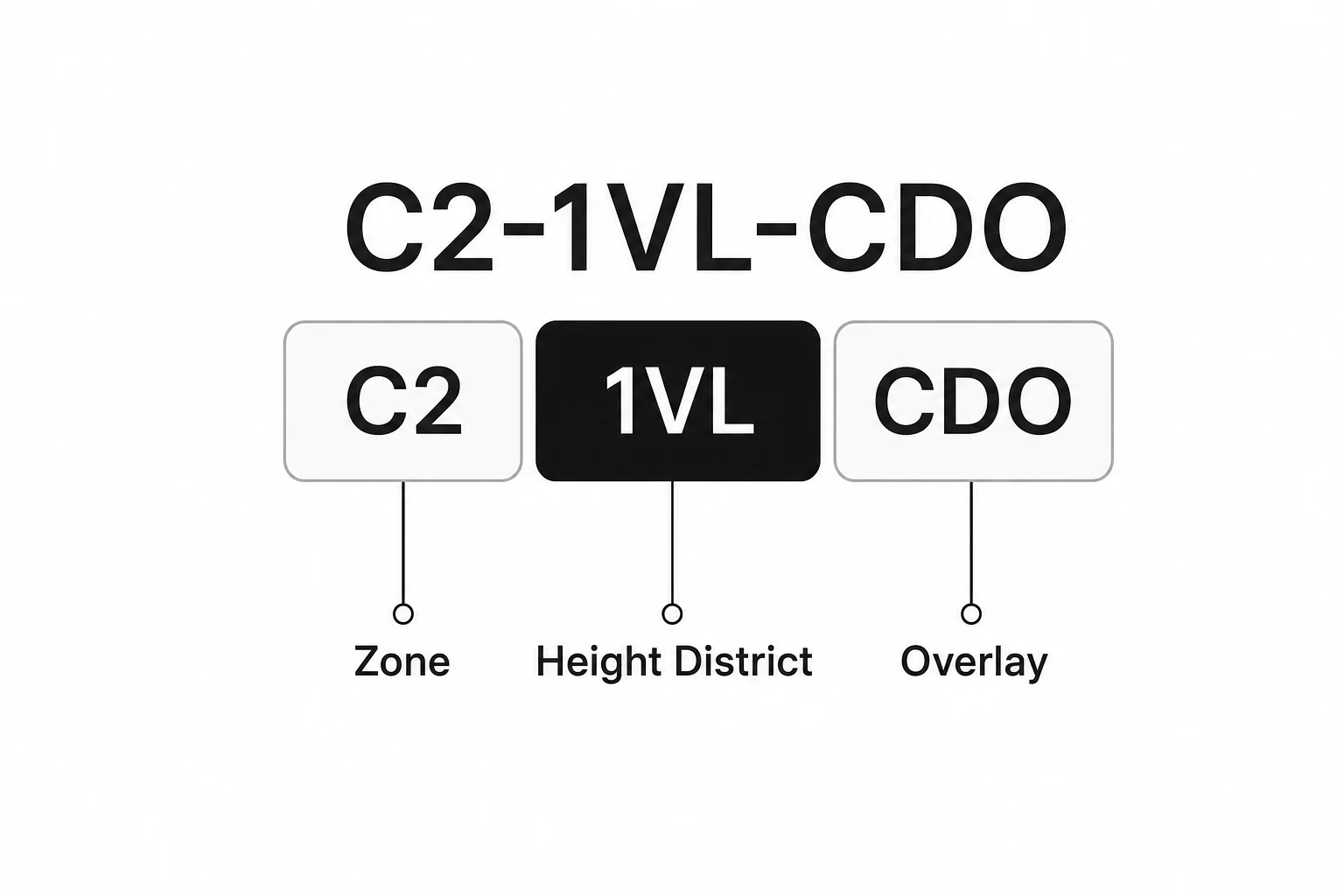
Under Chapter 1, a parcel's controls are encoded in a compact zone string like [Q]R3-1 or C2-1VL-CDO. Each part carries meaning:
- Prefix conditions — a T (Tentative) or Q (Qualified) classification attaches conditions that must be satisfied, e.g.
[Q]R3-1. - Zone class — the base zone (R1, RD1.5, R3, C2, M1, …) sets permitted uses and base density.
- Height District — the number/suffix after the dash (1, 1L, 1VL, 1XL, 2, 3, 4) sets maximum FAR and height.
- D Development Limitation — a -D suffix caps FAR or height below the base allowance.
- Overlays — suffixes such as -CDO (Community Design Overlay), -HPOZ (Historic Preservation Overlay Zone) or -SN (Sign District) add area-specific rules.
So C2-1VL-CDO reads as a C2 commercial zone, in Height District 1VL (very-limited height), within a Community Design Overlay. Decoding the full string for a specific lot — including any Q/T conditions and overlays — is exactly what GoCodebook returns with the controlling citation.
Common zones at a glance
A handful of zones cover most parcels. The base zone sets use and density; the height district and any conditions then refine what you can actually build.
| Zone | Category | Typical use |
|---|---|---|
| R1 | Residential | One single-family home per lot |
| RD1.5 / RD2 | Residential | Restricted-density multi-dwelling (lot area per unit) |
| R3 | Residential | Apartments at moderate density |
| R4 / R5 | Residential | Higher-density apartments |
| C2 | Commercial | Broad commercial uses plus most R4 residential |
| CM / M1 / M2 | Industrial | Commercial-manufacturing and light/heavy industrial |
Exact density, setbacks and parking come from the zone + height district together with any Q/D conditions, overlays or applicable specific plan — which is why two parcels in the same base zone can build very differently.
Height districts & development intensity
The height district in the zone string sets the maximum floor-area ratio (FAR) and building height. Commercial and many multifamily zones use this scale:
| Height District | Typical commercial FAR | Intensity |
|---|---|---|
| 1 (and 1L / 1VL / 1XL) | 1.5:1 | Lowest; the L/VL/XL modifiers further cap height & stories |
| 2 | 6:1 | Moderate |
| 3 | 10:1 | High |
| 4 | 13:1 | Highest (downtown cores) |
These FARs are the base allowance. Q and D conditions, specific plans, transit incentives and overlays frequently raise or lower them — verify the controlling standard for your parcel before designing.
From entitlement to permit: the process
A Los Angeles project generally moves through planning (does the use/zoning allow it, and does it need discretionary approval?) and then building (plan check, permits, inspections). By-right projects skip the discretionary step.

- Department of City Planning (DCP) — zoning, entitlements and CEQA environmental review.
- Zoning Administrator / Area & City Planning Commissions — variances, conditional uses and other discretionary approvals.
- Department of Building and Safety (LADBS) — plan check, building permits, inspections and the Certificate of Occupancy.
- LA Housing Department (LAHD) — RSO registration, rent and eviction rules, and affordable-housing covenants.
Unit counts and project scope are not final until LADBS issues the construction permits, even when a planning entitlement is already approved. Explore the statewide model codes LADBS enforces on our California Building Standards Code hub.
Incentive programs for more housing
Los Angeles offers several programs that add density or speed approvals, usually in exchange for affordable units:
- Transit Oriented Communities (TOC) — created under Measure JJJ; Tier 1–4 incentives (more density, less parking) the closer a site is to major transit and the more affordable units it provides.
- State Density Bonus — additional units and concessions for income-restricted housing under California law.
- Executive Directive 1 (ED1) — streamlined, ministerial review for qualifying 100% affordable projects.
- SB 9 — ministerial lot splits and up to two units per resulting lot in many single-family zones.
- ADUs — backyard homes with pre-approved standard plan options on single-family and multifamily lots.
Rent Stabilization Ordinance (RSO) & tenant rules
The Rent Stabilization Ordinance (RSO) generally applies to rental units in buildings with a certificate of occupancy issued on or before October 1, 1978, and can also cover certain replacement units. It limits annual rent increases and requires a legal cause to evict — stricter than, and working alongside, the statewide AB 1482 rent cap.
| Topic | Rule of thumb |
|---|---|
| Coverage | Buildings with a C of O on/before Oct 1, 1978 (plus certain replacement units) |
| Rent increases | Capped annually by a CPI-based formula within a set min–max band |
| Evictions | Require an enumerated legal ("just") cause |
| No-fault | Triggers tenant relocation assistance |
| Administration | LA Housing Department (LAHD); annual registration required |
The single biggest RSO question is the building's age — a certificate of occupancy issued on or before October 1, 1978 is the classic trigger for coverage. See our rent control overview.
Los Angeles also strongly supports Accessory Dwelling Units (ADUs) with streamlined review and pre-approved plan sets. Because RSO coverage and ADU eligibility both depend on the building's age, type and history, the safest move is to check the specific parcel — compare how San Francisco handles its own Rent Ordinance and ADU program.
Who this affects
Frequently asked questions
What is the difference between Chapter 1 and Chapter 1A in LA zoning?
Chapter 1 is the Original Zoning Code that still governs most of Los Angeles. Chapter 1A is the New Zoning Code adopted in 2024 under re:code LA; it restructures zoning and is being phased in by Community Plan area, starting with the Downtown Community Plan in 2025.
How do I read a Los Angeles zone string like [Q]R3-1?
From left to right: any prefix condition (T/Q), the zone class (e.g. R3), the height district (e.g. 1, 1VL, 4) that sets FAR and height, an optional -D development limitation, and any overlays (CDO, HPOZ, SN). So [Q]R3-1 is an R3 apartment zone in Height District 1 with qualified conditions.
What do LA height districts mean for FAR and height?
The height district sets maximum floor-area ratio and height: roughly 1.5:1 in District 1, 6:1 in District 2, 10:1 in District 3 and 13:1 in District 4 for commercial zones, with L/VL/XL modifiers further limiting height. Q/D conditions, overlays and specific plans can override these — verify for your parcel.
Is my Los Angeles unit covered by the RSO?
Generally, a rental unit is covered by the Rent Stabilization Ordinance if the building's certificate of occupancy was issued on or before October 1, 1978; certain replacement units can also be covered. The RSO caps rent increases and requires a legal cause to evict. See our rent control overview.
Who issues building permits in Los Angeles?
The Department of Building and Safety (LADBS) issues construction permits and performs inspections under the LA Building Code, which amends the statewide California Building Code. Planning entitlements are typically resolved before LADBS issues the permit.
What is the Transit Oriented Communities (TOC) program?
The TOC program, created under Measure JJJ, grants tiered (Tier 1–4) density and development incentives for projects that include affordable units near major transit. The closer to transit and the more affordable units, the greater the incentives.
Can I build an ADU in Los Angeles?
In most cases, yes. Los Angeles actively supports Accessory Dwelling Units with streamlined review and pre-approved plan sets for single-family and multifamily lots, layered on top of California's statewide ADU law.
General information, not legal advice.
More in Los Angeles code
- Overview
- Zoning Code (Chapter 1)
- Zoning Code (Chapter 1A)
- Rent Stabilization (RSO)
- Permits & Forms
- Zoning
- Land Use
- Development Standards
- Parking
- Design Review
- Overlay Districts
- Historic Preservation
- Signage
- Nonconforming Uses
- Variances and Exceptions
- Landscaping and Screening
- Accessory Dwelling Units (ADU/JADU)
- Full code text
Have a Los Angeles zoning or permit question?
Ask GoCodebook about any LA address and get a cited answer on Chapter 1 vs. 1A zoning, the zone string, height districts, LADBS permits, the RSO, TOC and ADUs.
Ask your question